 Ujjawal Laddha
Agency leaders and senior executives know that they need to scale operations as their agency grows.
And you must have felt it too. The mismatch between sales confidence and delivery confidence.
When you are onboarding a steady stream of clients, you have to build a delivery system that can keep up.
Usually, for web development companies with their own philosophy, processes, and tech stack, there are two options going forward.
Hire in-house developers or partner with a white label web development agency.
In this article, let’s look at the pros and cons of expanding web development execution capacity via in-house hires and white label developers.
What Agencies are Actually Choosing Between (And What They’re Not)
Generally, decision-makers in web development companies approach this with a simple “hire vs outsource” mental model. It is simple and makes sense.
However, that gives you limited insights. You can only see what’s visible on the surface at the moment, such as cost and quality control.
But that’s only a part of the picture.
The real areas of difference are ownership and execution.
Ownership defines who is in charge, and execution focuses on what needs to be done to complete the build.
The ideal option is where you remain in control while scaling up execution.
Here, control doesn’t mean micromanaging every aspect of the project, but rather providing the framework, which includes the workflow, operating procedures, tool recommendations, and quality standards.
When you use the “hire in-house vs white label web developer” mental model, you are more likely to spare little attention to expanding in control or sustainable growth.
Additionally, with new pending projects on the table, agency leaders’ focus shifts primarily to getting things done that deliver polished websites.
What Hiring an In-house Web Developer Really Looks Like for Agencies
When choosing between hiring in-house vs white label web developers, it’s beneficial to visualize how both might look for you, starting with the former.
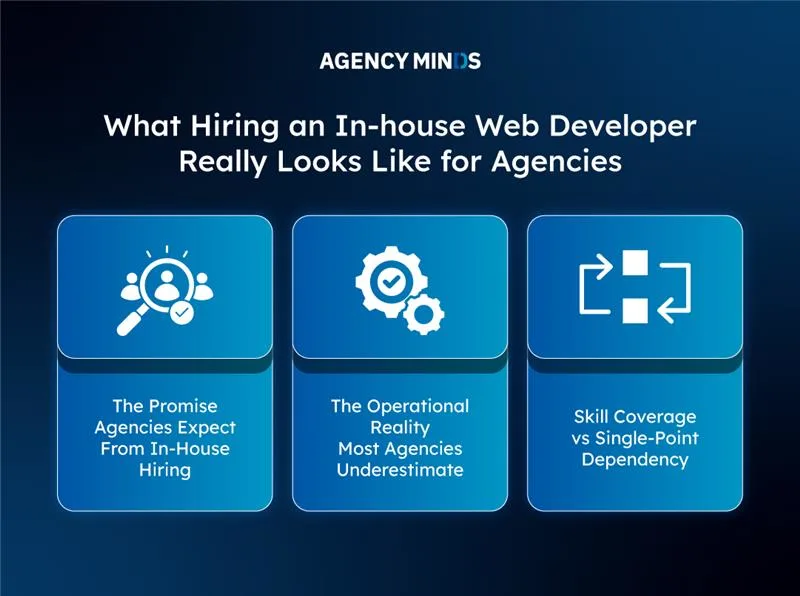
The Promise Agencies Expect From In-House Hiring
In-house hires promise granular control, immediate responsiveness, and complete organizational alignment.
You know exactly what each of the developers is working on right now, who’s managing them, and how they are completing builds.
The underlying guarantee is that such close visibility over internal web development operations will ensure predictable execution. It will allow you to meet deadlines while meeting your client’s website expectations.
But is it actually fulfilled?
The Operational Reality Most Agencies Underestimate
Agencies, even the ones with experienced leadership, underestimate the investment required to increase web development capacity via internal hiring.
First, you must pay your full-time web developers salary, and that’s just the beginning.
The hiring process in itself is a continuous one. A large workforce needs constant maintenance. You need to have a dedicated human resources team that ensures you have the right folks in the right departments at all times.
This translates to an ongoing recruiting process that works to replace any professionals leaving the organization.
Moreover, more developers mean more people to manage operations.
All of it quickly ramps up the daily overhead expenses in terms of process, personnel, and infrastructure (physical and digital).
Apart from that, you have to give your employees benefits, such as paid time off, insurance, and other perks.
And it is all for one single new professional in your team.
Agencies rarely hire one developer when looking to scale their delivery capacity. Typically, you need professionals for every aspect of building a website, such as backend, frontend, testing, and CMS customization.
Then, you have to train them on your workflows and processes, which means even more delay before you start seeing the promised benefits.
Skill Coverage vs Single-Point Dependency
As if the aforementioned financial risk and mental stress aren’t enough, agency leaders also need to deal with the evolving complexity of web development.
Websites are constantly changing due to the evolving preferences of their audience.
It goes beyond aesthetics. You also have to keep up with the new technical possibilities around CMS setup, performance optimization, third-party integration, QA, and content management.
Of course, you will need multiple experts in the team to cover all the aspects of modern web development.
And that creates knowledge dependency and bottlenecks.
The new hires will depend on experienced professionals, who may not be available at all times, for process guidance and deliverable approval.
This makes your entire operation fragile with a single point of failure.
If they are suddenly unavailable for an extended period or leave the team, you may struggle to get your operations back in terms of quality and efficiency.
When Hiring In-house Does Make Sense for Agencies
With all of the above being said, there are certainly use cases when you can hire more developers directly rather than partnering with a white label web development company.
If you are offering core web development services that are productized, and you are seeing consistent demand, at least on a quarterly basis, hiring internal team members can be advantageous.
With strong technical leadership, a large but close-knit team can scale up your execution capacity for the long-term.
Again, you still have to go through the arduous recruitment, onboarding, and training process, which may always run in the background, which may be suboptimal for growth-stage agencies that need to deliver more quickly.
What Working with a White Label Web Developer Looks Like at Scale
Simply put, you can increase your delivery capacity quickly without a proportionate increase in operational complexity.
White Label Explained the Agency-Native Way
White label web developers act as an extension of your agency’s execution arm.
You sell your services, define the scope, set the pricing, and manage client relationships as usual. The white label partner quietly delivers the builds behind the scenes.
Of course, your outsourcing partner will be bound by an NDA, ensuring you remain client-facing with complete control over the web development process.
How White Label Solves the Capacity Problem
Web development agencies know that the number of ongoing projects varies throughout the year, requiring them to have different capacities.
The right white label partner can scale your execution capacity up or down depending on demand. Consequently, you are no longer locked into fixed staffing decisions while maintaining flexibility.
If you suddenly onboard new clients with complex requirements, your white label development team can instantly allocate more resources for your agency. At the same time, during slow months, such a model alleviates payroll pressure.
Why Process Matters More Than Raw Talent
Seasoned white label web development agencies like AgencyMinds operate on proven, repeatable processes. This creates predictable timelines based on the project’s scope, without compromising quality.
Additionally, since you will be in control in white label partnerships, you can outline your internal QA processes to ensure your exact standards are upheld.
As your needs grow, new requirements can easily slot into existing processes and workflows seamlessly, which is just what growing agencies need.
In the case of internal hiring, the focus is primarily on the credentials of the developer, rather than on how the new team member can contribute to a more resilient workflow.
While the capabilities of individual contributors are essential, long-term growth without compromising standards demands more: reliable operations.
Where Agencies Get This Decision Wrong (and How It Hurts Later)
Internal hiring feels safe.
When there are too many clients at the door, and you need to deliver, it’s natural to do what you know works, which is running operations under your roof.
And on some level, it is true.
You can run scaled-up web development operations in your company by simply increasing the headcount, especially when you have already done it before.
Under pressure, agency leaders may overlook the associated challenges that will emerge down the line.
This is exactly where established web development agencies go wrong.
Making growth decisions, such as whether to hire in-house or white label web developers for scaling delivery, under pressure.
For the most part, it is understandable because senior executives have to manage reputation risk while managing delivery anxiety in the face of high demand.
However, you need to take a moment to realize the long-term impact, which is operational complexity, extra recurring costs, and eventually margin erosion.
A Practical Decision Framework for Agency Founders

To keep things straightforward, ask yourself the following questions:
- Is web demand predictable for the next 6-12 months?
- Do we need one skill or many?
- Can we afford paid downtime?
- Do we want to manage developers or delivery outcomes?
- What happens if demand drops for 60 days?
If you think that the demand will be uncertain, which is usually the case in web development, and you want to manage more clients than development teams, then white labeling is safer.
It will give your agency the flexibility it needs while scaling your delivery capacity as needed.
AgencyMinds: Your Perfect White Label Web Development Partner
AgencyMinds is a leading white label web development company that helps established agencies serve more clients without additional internal hiring or operational complexity.
Our battle-tested workflows are specifically designed to scale delivery while giving you complete control over client relationships, scope, process, and quality standards.
We will reserve resources in long-term partnerships and will scale up and down based on your demand to support your execution needs dynamically.
Ready to explore the next growth chapter of your web development agency?
Frequently Asked Questions
Reliability depends on systems, not employment type. In-house developers can leave, get overloaded, or become bottlenecks. Established white label partners rely on documented processes and redundancy, which often delivers more consistent timelines and predictable execution.
No, control stays with your agency. You manage scope, communication, timelines, and quality standards. A white label partner focuses purely on execution, operating behind the scenes while you remain fully client-facing and accountable.I
White labeling makes sense when demand fluctuates, skills vary by project, or speed matters. Growth-stage agencies benefit most, especially when hiring feels risky, slow, or expensive compared to flexible, on-demand execution capacity.
Yes, experienced white label teams routinely handle complex builds. Their advantage is specialization and process maturity. With clear requirements and oversight from your agency, they can deliver high-stakes projects reliably and at scale.