 Ujjawal Laddha
Growing agencies need delivery confidence and operational control.
And those goals are rarely achieved by getting more hands on deck.
It might feel logical or sensible to expand the internal team or have external resources on standby. This increased execution capacity feels like readiness.
However, this feeling disappears when you start scaling.
You experience hesitancy when committing to clients’ delivery timelines.
Every day, you spend hours putting out fires and attending to recurring urgent issues.
There’s rework, process inconsistency, and bottlenecks — at scale.
That’s when you realize capacity and confidence are two different things.
Yes, your team can now work on more projects concurrently, but it has less control over the predictability of daily operations.
Fortunately, you can solve this challenge with the right white label partnership.
In this article, let’s look at how the right white label partner can help your agency regain operational control, allowing you to grow confidently.
What “Confidence” Actually Means in Agency Delivery
Confidence in agency delivery means you calmly commit to your clients’ project requirements and timelines rather than onboarding more clients.
When you are confident, you provide concrete timelines in the proposal, explain the scope without “ifs” and “buts,” and ensure smooth execution despite shifting priorities.
At the same time, a lack of delivery confidence is visible too.
You soften commitments with vague language. Before kicking off, you over-explain the potential risks to protect yourself in case of delays. During execution, the status updates read like explanations instead of a list of tasks finished or deliverables shared.
And your clients feel it as well, even when things are going fine on paper.
Additionally, your team members feel it internally as well. They struggle to gain clarity on what’s next while running unstandardized workflows. There will be approval or quality bottlenecks leading to avoidable delays.
Interestingly, it’s not about talent or effort.
You and your team might be putting in more hours to close more tasks by the minute, trying to meet your clients’ expectations.
Rather, it’s about scaling execution while maintaining control.
If your processes are robust and the responsibilities of each professional are transparently explained, it’s easy to handle the pressure as projects stack up.
But without standardized procedures and a shared definition of done, you start to second-guess yourself when committing to your clients confidently.
Where Agency Confidence Breaks Down as They Grow
Delivery confidence breaks when you start double-checking timelines and scope by taking a “can we commit?” pause before sending a proposal.

And it usually happens when you have multiple projects in the pipeline.
Keep in mind that your confidence breaks only around delivery, not the quality of work.
Your developers and designers still do great work that you can stand by. Everything from quality assurance checking to delivery handoff remains solid.
Moreover, you may still have a surplus of human resources.
Despite all of that, you need to constantly attend to deadlines because delivery feels fragile. There’s always a nagging thought of “what if” in the background.
To be honest, the above symptoms can be a good thing.
Instead of viewing them as failures, look at them as an upgrade signal for your current operating structure. You don’t need a complete overhaul of how you do things at all.
Just a shift in focus toward predictable delivery capacity and comprehensive operational control without micromanagement.
Why Adding More Resources Doesn’t Restore Confidence
When you are growing rapidly, and there are more clients than you can handle, hiring more internal team members to increase capacity is an obvious solution.
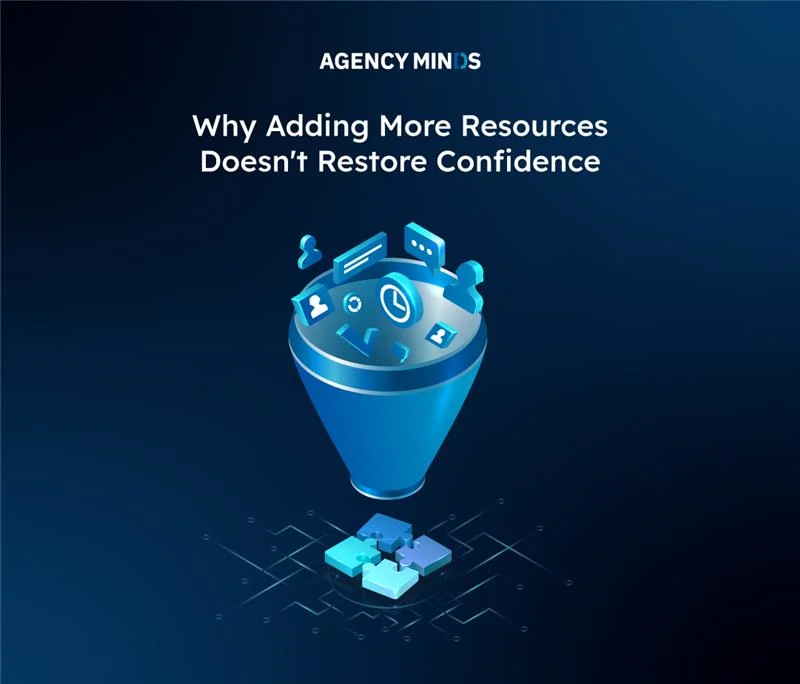
In fact, most companies, not just agencies, are guilty of it at some point in their journey.
But the reality is quite different than what you may have envisioned.
- Second, more developers and designers mean more managerial overhead and tooling expenses. You will need more professionals to handle the administrative tasks around them.
- First of all, recruiting and human resource management are continuous processes in themselves. They always run in the background to maintain your workforce and put a dent in your wallet.
This demands more from senior executives of your agency. Their attention gets spread thin because the new team members need their approval on deliverables.
Consequently, you spend more resources on staying aligned than on doing actual work that delivers value to your clients.
Similar challenges persist if you go with freelancers. Working with independent contractors might feel quick and flexible until you start dealing with external dependencies that affect quality and punctuality.
Additionally, handing over confidential client work to freelancers increases compliance risk significantly. Any mishap and you strain the relationship forever.
The point is, even if you add more resources, you are still at square one in terms of delivery confidence.
On paper, your agency can deliver more websites or design creatives.
But you may still need to look over your shoulder to know everything is okay before agreeing to a project’s scope and timeline.
How White Label Partnerships Create Confidence at a Structural Level
Confidence demands structure.
Structured execution keeps workflows and processes predictable, allowing you to assess your delivery capacity in terms of project scope and timeline.

White label agency partnerships do just that.
They introduce clear ownership across projects where every phase is executed based on pre-defined rules. This ensures your workflows and systems become repeatable while maintaining consistency.
Over time, this consistency enables your team to work in familiar rhythms instead of improvising solutions on the go. Professionals can assure you about delivery timelines confidently, which will reflect in client conversations.
Experienced white label web design and development agencies take it a step further by integrating their workflow with yours. The extra alignment eventually becomes the structural confidence layer your team can rely on.
And you can feel this when running internal operations as well.
The designers and developers in your team can absorb new work with overlapping deadlines without delaying ongoing projects.
Senior managers and executives won’t spend hours resolving urgent, unprecedented issues but would rather direct them toward established escalation paths.
How Confidence Quietly Improves Agency Profitability
The delivery confidence from a strong white label partnership translates to operational control, which will be visible in client-facing conversations.
- You will price your services with more conviction. To sweeten the deal, you may offer a discount, not out of desperation, but because you would want to work with the client.
- When suggesting deadlines based on a project’s scope, you will give more realistic and grounded numbers instead of agreeing to what the client suggests to close the deal.
Internally, your operations will become much more streamlined.
The white label agency partner will execute your client’s project following your guidelines, simplifying the collaboration and handoff. Your senior executives will spend fewer hours addressing client comments and reworking, ensuring predictable delivery.
Truth to be told, white label partnerships don’t directly boost your margins.
They just scale your execution capacity seamlessly, which allows you to become more profitable.
All of it without aggressive internal hiring or operational complexity.
When White Label Partnerships Fail to Increase Confidence
“We tried white labeling, and it didn’t give us more delivery ‘confidence’.”
Failed white label partnerships usually share a common denominator: a transactional approach.
When agencies want to increase execution capacity quickly, they often look for partners who can do more quickly. This approach works initially. You assign them one-off tasks, and they complete them within the deadlines.
Due to the initial success, even successful agencies make oversights when setting up foundational processes and workflows. After all, why break something that works?
However, this transactional model breaks if you progressively increase the task complexity.
For instance, your white label partner may not effectively translate your client’s business objectives into specific deliverable requirements that match your standards.
In such situations, you will remain hesitant while committing to newer client projects.
On paper, you still have a higher capacity. But that will rarely become delivery confidence in operation.
A confidence-focused white label partnership is based on a structural relationship where you remain fully in control.
You manage the client relationships, outline the workflows, define the quality standards, and assign the scope. The white label partner simply executes it within that framework.
AgencyMinds: Get Delivery Confidence That Unlocks Growth
AgencyMinds is a leading white label partner that helps established agencies regain delivery confidence through structure.
We will increase your delivery capacity while operating within your framework to meet your clients’ expectations.
Our team will adopt your philosophy, workflow, and tools to develop repeatable processes that give you confidence where it matters most: delivery.
Ready to Grow Your Agency Confidently?
Get the technical support your agency needs to grow faster, deliver better, and scale without risk.
Frequently Asked Questions
No. White label partnerships help agencies at many stages. Smaller teams use them to stay lean and reliable. Growing agencies use them to stabilize delivery. The value comes from structure and predictability, not agency size alone.
Confidence drops when the partnership stays transactional, where the white label agency is there to quickly increase delivery capacity for one-off tasks. Confidence grows only when the relationship is structural, focusing on delivery standards, accountability, and workflows.
You’re ready when delivery pressure feels higher than comfort. Missed timelines, hesitation during proposals, or constant firefighting are clear signals. A white label partner works best when you want structure, not just speed or short-term relief
No. White label partnerships complement in-house teams. Your core team owns strategy, clients, and standards. The partner strengthens execution and capacity. Confidence improves when both work together within a clear delivery framework.
It depends on intent. Used transactionally, it solves short-term capacity issues. Used strategically, it becomes a long-term delivery model. Agencies that treat it as infrastructure gain lasting confidence and controlled growth.